
Check Engine Light Tool: How AI Car Diagnostics Help You Figure It Out
That amber glow on your dashboard can trigger instant anxiety. A check engine light is a warning indicator on your vehicle's dashboard that alerts the driver to a potential problem within the engine or emission system. The causes range from a loose gas cap to a failing catalytic converter. The good news: you no longer need to drive blind to a mechanic or buy an expensive scanner. AI-powered diagnostic tools now let you describe your car's symptoms in plain language and receive an accurate, repair-verified diagnosis in seconds. This guide covers what triggers the light, how different tools work, and why platforms like AutoUncover are changing the game for everyday car owners in the United States.
What Is the Check Engine Light?
A check engine light (CEL) is a tell-tale that your vehicle's computerized engine-management system uses to indicate a malfunction. When illuminated, the Engine Control Unit (ECU) stores a Diagnostic Trouble Code (DTC) that can be retrieved with a scan tool.
A DTC is a standardized five-character alphanumeric code defined by the OBD-II standard. Generic codes (P0xxx) apply to all OBD-II vehicles made since 1996, while manufacturer-specific codes (P1xxx) require brand-specific references. Understanding this distinction matters when you choose a diagnostic path.
Solid vs. Flashing Light
A solid CEL usually indicates a non-urgent issue that still deserves prompt attention. A flashing check engine light signals a severe fault, often a misfire that can damage the catalytic converter. If yours is flashing, pull over safely and seek professional help immediately.
Most Common Causes of a Check Engine Light
Several issues trigger the CEL more often than others. Here are the top culprits based on industry repair data:
- Loose or damaged gas cap (EVAP leak codes like P0455)
- Oxygen sensor failure (codes P0130 through P0167)
- Catalytic converter efficiency (code P0420)
- Mass airflow sensor (code P0101)
- Engine misfires (codes P0300 through P0312)
According to Edmunds, an inexpensive code reader can give car owners one more data point when talking with their mechanic. But reading the code is only the first step. The real challenge is interpreting what it means for your specific vehicle.
Your Diagnostic Tool Options
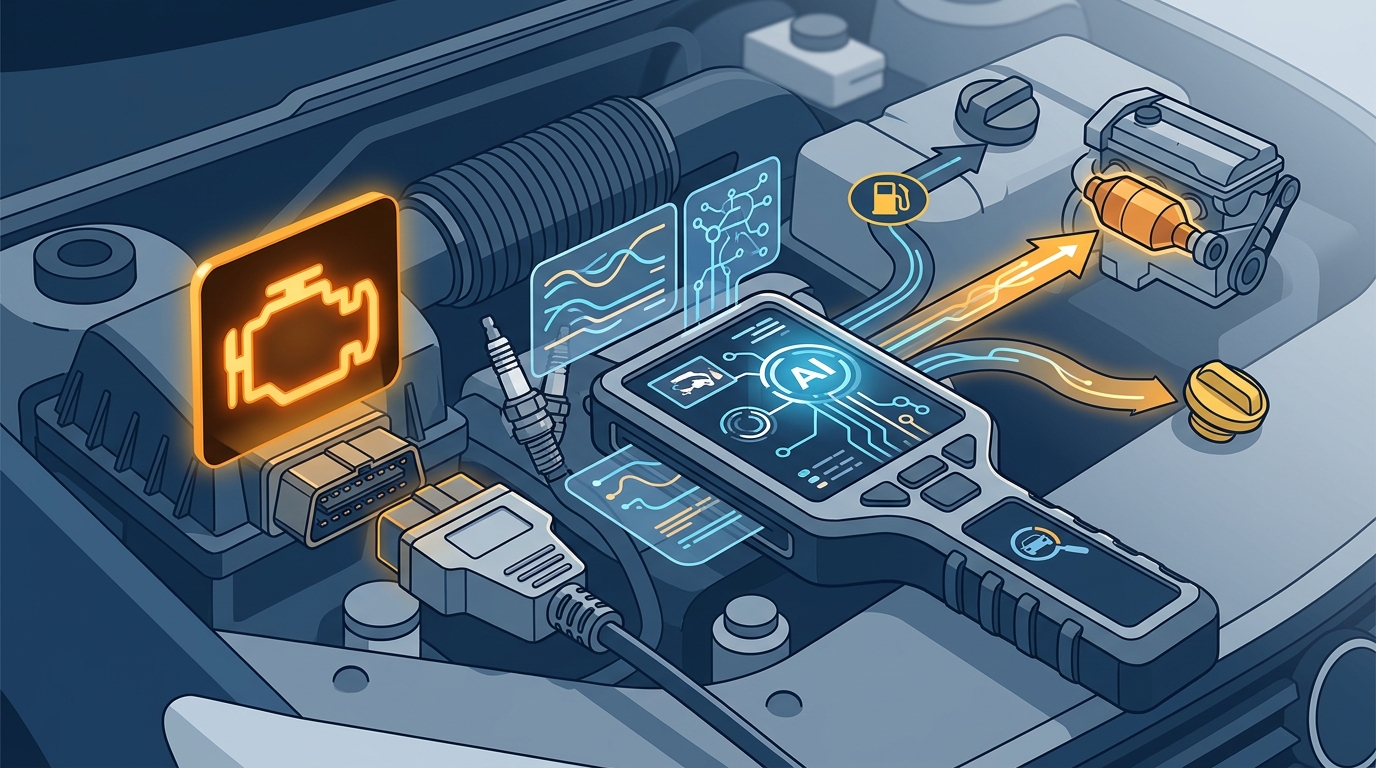
Car owners today have three main categories of check engine light tools:
1. Basic OBD-II Code Readers
An OBD-II code reader is a handheld device or Bluetooth dongle that connects to the 16-pin port under your dash. It reads and clears DTCs. Prices start around $20. The limitation: it gives you a code but not a diagnosis.
2. In-Store Free Scan Services
Retailers like AutoZone and O'Reilly Auto Parts offer free code-reading services. These are convenient but still require you to interpret results or trust a parts counter recommendation.
3. AI-Powered Diagnostic Platforms
An AI car diagnostic tool is software that uses artificial intelligence to analyze symptoms, fault codes, and repair data to identify the most likely root cause. Unlike basic readers, these platforms go beyond the code to explain what is actually failing and what to do about it. AutoUncover is one such platform, and it verifies its diagnoses against real-world repair outcomes.
Why AI Diagnostics Are Different
Traditional code readers tell you what code is stored. AI diagnostics tell you why that code appeared and what to check first. This matters because a single DTC can have dozens of possible causes.
For example, a P0420 code could point to a worn catalytic converter, a leaking exhaust manifold, or even bad spark plugs causing unburned fuel. An AI tool cross-references your symptoms, vehicle year, and repair history to narrow the list. S&P Global Mobility reported the average age of U.S. light vehicles reached 12.8 years in 2025, which means more sensors and more intermittent faults to track down. AI helps you avoid the costly trial-and-error cycle of replacing parts that are not actually broken.
How AutoUncover Works
AutoUncover takes a symptom-first approach. Instead of plugging in a scanner, you simply describe what your car is doing on the platform. The AI analyzes your description against a database of verified repairs and returns a prioritized list of likely causes.
Every diagnosis on AutoUncover is verified by real repair outcomes, not just code-lookup tables. You can also explore its comprehensive fault code library to look up any DTC your vehicle has stored. If you want deeper analysis or unlimited queries, the AutoUncover Premium plan unlocks additional features.
Tool Comparison Table
| Feature | Basic OBD-II Reader | Free In-Store Scan | AutoUncover AI |
|---|---|---|---|
| Cost | $20 - $60 | Free | Free / Premium |
| Reads DTCs | Yes | Yes | Yes (via symptom input) |
| Root Cause Analysis | No | Limited | Yes, AI-driven |
| Verified by Real Repairs | No | No | Yes |
| No Hardware Required | No | No (visit store) | Yes (browser only) |
| Available 24/7 | Yes (if owned) | Store hours only | Yes |
Key Takeaways
- A check engine light signals an engine or emissions fault detected by your car's ECU.
- A flashing CEL indicates a severe problem; a steady light calls for prompt but non-emergency service.
- Basic OBD-II scanners read codes but do not diagnose root causes.
- AI diagnostic tools like AutoUncover analyze symptoms against real repair data to pinpoint problems.
- The average U.S. vehicle is now over 12 years old, making reliable diagnostics more important than ever.
- You do not need to buy hardware to get answers; browser-based AI tools work from your phone.
- Always verify a diagnosis before ordering parts to avoid unnecessary spending.
Frequently Asked Questions
What does a check engine light mean?
A check engine light means your vehicle's onboard computer has detected a fault in the engine, transmission, or emissions system. It stores a DTC that points toward the affected circuit or component.
Can I drive with the check engine light on?
If the light is solid and the car feels normal, you can usually drive short distances to a shop. If the light is flashing, stop driving as soon as safely possible to prevent catalytic converter or engine damage.
Is there a free tool to diagnose my check engine light?
Yes. AutoUncover offers a free AI-powered diagnostic where you describe your car's symptoms and receive repair-verified results. Auto parts stores like AutoZone and O'Reilly also read codes at no charge.
How does AI car diagnostics work?
AI car diagnostics uses machine learning models trained on thousands of real repairs to match your symptoms and fault codes to the most probable root cause, rather than simply listing code definitions.
Do I need an OBD-II scanner to use AutoUncover?
No. AutoUncover lets you describe what your car is doing in plain language. The AI interprets your symptoms without requiring any hardware connection.
What is a DTC?
A Diagnostic Trouble Code (DTC) is a standardized alphanumeric code stored by your vehicle's ECU when it detects a fault. You can look up any code in the AutoUncover fault code database.
How accurate are AI diagnostic tools?
Accuracy depends on the data behind the tool. AutoUncover verifies its AI diagnoses against actual repair outcomes, which helps reduce misdiagnosis and unnecessary part replacements.
Should I go to a mechanic after using an AI tool?
For complex or safety-related issues, always confirm with a qualified mechanic. An AI diagnosis gives you a strong starting point so you can have an informed conversation and avoid unnecessary upsells.
Get Your Free AI Diagnosis Now
Stop guessing about your check engine light. Visit AutoUncover.com, describe your car's symptoms, and get a repair-verified diagnosis in minutes. No scanner needed, no appointment required.