
Modern vehicle diagnostics have shifted from heavy garage equipment to smartphone screens, but the market is saturated with tools making bold claims. According to a 2024 industry analysis by J.D. Power, over 60% of drivers now attempt to troubleshoot minor vehicle issues before visiting a professional shop. This surge in DIY automotive care has created a demand for reliable software that bridges the gap between consumer curiosity and professional-grade data. However, not all diagnostic applications deliver accurate results, and many free tools suffer from limited functionality or outdated database support. Understanding the distinction between basic code readers and comprehensive diagnostic platforms is essential for saving money without compromising vehicle safety. (AutoUncover AI car diagnostics)
Understanding Car Diagnostic Technology
Before selecting an app, it is crucial to understand the underlying technology. On-Board Diagnostics (OBD) is a standardized system in vehicles that monitors engine performance and emissions. The OBD-II port, typically located under the dashboard near the driver's seat, serves as the gateway to this data. When a vehicle's computer detects an issue, it stores a Diagnostic Trouble Code (DTC). These codes provide a standardized language that allows any compatible scanner to identify the general area of the problem, such as the fuel system, ignition system, or emissions control.
However, reading a code is only the first step. The real value lies in interpreting that code within the context of your specific vehicle's history and current sensor data. This is where the difference between a basic free app and a professional-grade tool becomes apparent. Basic apps often provide generic definitions that may not apply to your specific make and model. In contrast, advanced platforms utilize proprietary databases and real-time data streams to offer precise troubleshooting guidance.
Evaluating Free Diagnostic Applications
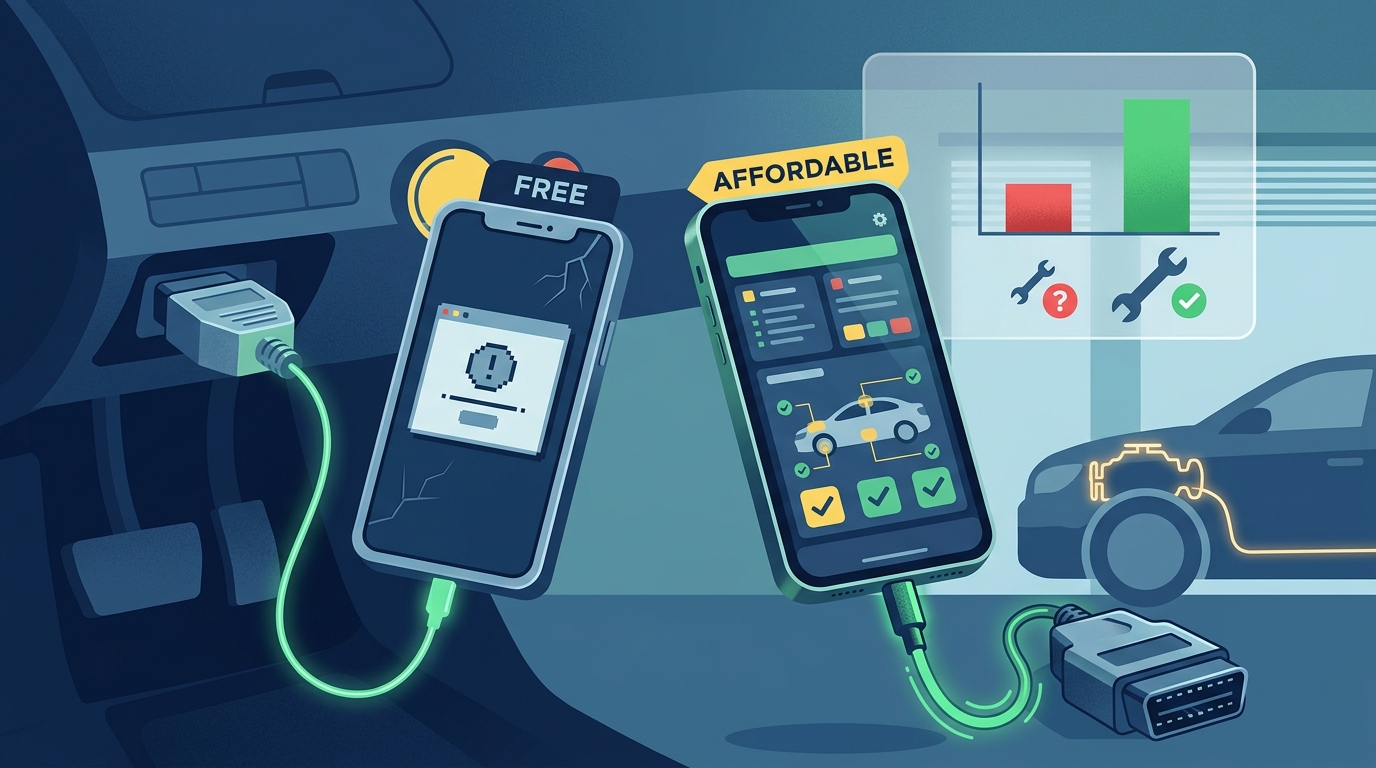
Free diagnostic apps are widely available on both iOS and Android platforms. They typically require a separate OBD2 Bluetooth or Wi-Fi adapter, which costs between $15 and $30. While these tools are accessible, they often come with significant limitations. Most free applications focus exclusively on reading and clearing standard OBD-II codes. They rarely provide access to live sensor data, such as oxygen sensor voltages or fuel trim levels, which are critical for diagnosing intermittent issues.
Furthermore, the accuracy of free apps can vary significantly. Many rely on user-generated databases that may contain outdated or incorrect information. For example, a code indicating a misfire in cylinder three could be caused by a faulty spark plug, a bad ignition coil, or a fuel injector issue. A free app might simply tell you the code definition without offering the nuanced steps to isolate the root cause. This lack of depth can lead to unnecessary part replacements and increased repair costs.
Despite these limitations, free apps can be useful for basic maintenance tasks. If your check engine light is on due to a loose gas cap, a free app can confirm this simple issue. However, for complex mechanical problems, relying solely on free software is risky. The data shows that professional diagnostic tools reduce diagnostic time by up to 40% compared to manual troubleshooting methods. This efficiency translates directly to cost savings for both professional mechanics and informed DIY enthusiasts.
Affordable Premium Diagnostic Tools
Affordable premium diagnostic applications offer a middle ground between basic free tools and expensive professional scanners. These apps typically require a subscription or a one-time purchase ranging from $20 to $100. They provide access to manufacturer-specific codes, live data streaming, and advanced bi-directional controls. Bi-directional controls allow the user to command vehicle components, such as activating a cooling fan or testing a fuel pump, directly from the smartphone.
Platforms like AutoUncover leverage AI to verify diagnostics through real repair data. This approach ensures that the information provided is not just theoretically correct but practically applicable. By analyzing millions of repair records, these tools can predict the most likely cause of a problem with high accuracy. This reduces the guesswork involved in automotive repair and increases the likelihood of a successful first-time fix.
Another key advantage of premium tools is their ability to perform system-specific tests. For instance, an EVAP system test can identify small leaks in the fuel vapor system that standard code readers miss. These tests require specialized algorithms that are not available in free applications. Additionally, premium apps often include detailed repair procedures, wiring diagrams, and technical service bulletins (TSBs). This wealth of information empowers users to make informed decisions about their vehicle's maintenance.
Feature Comparison Matrix
The following table summarizes the key differences between free and affordable premium diagnostic tools. This comparison highlights the functional gaps that often lead to poor diagnostic outcomes when using basic software.
| Feature | Free Diagnostic Apps | Affordable Premium Tools |
|---|---|---|
| Code Reading & Clearing | Standard OBD-II Codes Only | Standard & Manufacturer-Specific Codes |
| Live Data Streaming | Limited or None | Full Real-Time Sensor Data |
| Bi-Directional Controls | Not Available | Available for Supported Vehicles |
| Repair Guidance | Generic Definitions | AI-Verified Repair Procedures |
| Cost | $0 (Plus Hardware) | $20 - $100 (Plus Hardware) |
Key Takeaways
- Hardware is Essential: No app can function without an OBD2 adapter. Budget $15 to $30 for a reliable Bluetooth or Wi-Fi scanner.
- Free Apps Have Limits: They are suitable for basic code reading but lack the depth needed for accurate troubleshooting.
- Premium Tools Save Money: Access to manufacturer-specific data and repair procedures reduces the risk of incorrect repairs.
- AI Verification Matters: Tools that verify diagnostics against real repair data, such as those found on AutoUncover, provide higher accuracy than generic databases.
- Bi-Directional Control: Premium apps allow you to test components, which is crucial for diagnosing intermittent electrical issues.
- Subscription Models: Many affordable tools offer annual subscriptions that provide continuous updates and access to new vehicle data.
Frequently Asked Questions
Do I need a specific OBD2 adapter for my phone?
Yes, you need an OBD2 adapter that connects to your smartphone via Bluetooth or Wi-Fi. Ensure the adapter is compatible with your phone's operating system, whether iOS or Android. High-quality adapters provide stable connections and faster data transfer rates.
Can free apps diagnose all car problems?
No, free apps are limited to reading standard OBD-II codes. They cannot access manufacturer-specific systems or perform advanced tests like EVAP leaks or transmission fluid temperature monitoring. For comprehensive diagnostics, a premium tool is necessary.
How much does a good diagnostic app cost?
Affordable premium diagnostic apps typically cost between $20 and $100 per year. Some offer one-time purchases, but subscriptions ensure you receive updates for new vehicle models and software improvements. The cost is minimal compared to the potential savings from avoiding unnecessary repair shop visits.
Are diagnostic apps accurate for all vehicle makes?
Accuracy varies by vehicle make and model. Premium apps usually have better coverage for specific manufacturers like Ford, GM, Toyota, and BMW. Always check the app's compatibility list before purchasing to ensure it supports your specific vehicle year and model.
Can I clear my check engine light with an app?
Yes, most diagnostic apps allow you to clear the check engine light. However, this only removes the code from the computer's memory. If the underlying issue is not fixed, the light will return. It is crucial to diagnose and repair the problem before clearing the code.
What is the difference between OBD-II and manufacturer-specific codes?
OBD-II codes are universal across all vehicles manufactured after 1996. Manufacturer-specific codes are unique to each brand and provide more detailed information about system-specific issues. Premium apps access both types of codes for a more complete diagnostic picture.
Do I need to install software on my computer?
No, modern diagnostic apps run directly on your smartphone or tablet. They connect to the OBD2 adapter wirelessly, eliminating the need for a laptop or desktop computer. This portability allows you to diagnose your vehicle anywhere, whether in your driveway or at a remote location.
Start Diagnosing with Confidence
Choosing the right diagnostic tool can save you hundreds of dollars in repair costs and provide peace of mind. While free apps offer a basic entry point, affordable premium tools provide the depth and accuracy needed for reliable vehicle maintenance. By leveraging AI-verified diagnostics and comprehensive data access, you can tackle automotive issues with confidence. Visit AutoUncover Garage to explore our advanced diagnostic solutions and start saving on your vehicle repairs today. For more information on our services, check out our Pricing page or learn more about our technology on the Help center.